
Ford Bronco Maintenance and Service Guide
Whether you are conquering the muddy trails at the Richloam Wildlife Management Area, handling the daily commute down Interstate 4, or hauling gear towards your next gig, your Ford Bronco is built for adventure.
With its rugged heritage, advanced EcoBoostFord engines, and sophisticated
Terrain Management SystemFord, the Bronco is an incredible machine. However,
maintaining that legendary off-road capability and on-road reliability requires
proper care.

At Jarrett Scott Ford, we understand that a Bronco is more than just an
everyday commuter, it is an investment in freedom.
To keep your SUV performing at its absolute peak, staying on top of routine
upkeep is essential.
From quick fluid refreshes to complex driveline care, here is your guide
to Ford Bronco service and maintenance Plant City, detailing what you need to
know about the critical pillars of Bronco health.
What
Is the Ford Bronco Service Schedule?
Sticking to the recommended Ford Bronco service schedule is one of the
best ways to protect your SUV, especially if you use it for off-road driving,
towing, or other demanding conditions. Ford’s Bronco owner’s manual separates
maintenance into normal, severe, and extreme use, with shorter intervals for
harder driving.
Here is a general Ford Bronco service schedule to follow if you drive
mostly in normal conditions, with a shorter timeline if you use your Bronco for
off-road trails, towing, mountain driving, or extended idling.
Important Note: Maintenance needs can vary by model year, engine, and driving style.
Ford’s Bronco owner’s manual is the final reference for your exact vehicle, and
Ford recommends following the severe-service chart if you regularly drive in
dusty conditions, off-road terrain, extreme temperatures, heavy traffic, or
while towing.
|
Interval (Miles/Time)
|
Service Task
|
The Need for Service
|
|
7,500–10,000 (or annually)
|
Engine oil & filter change
|
Oil degrades with heat and use
|
|
7,500–10,000 (or annually)
|
Tire rotation
|
Helps even out wear, especially on 4x4 use
|
|
7,500–10,000 (or annually)
|
Multi-point inspection
|
General vehicle health check
|
|
5,000–7,500
|
Severe-service oil & filter change
|
Recommended for off-road, towing, mountain driving, extended
idling, or extreme hot/cold use
|
|
20,000
|
Cabin air filter
|
Helps keep airflow clean
|
|
30,000
|
Engine air filter
|
Helps keep dirt and debris out of the engine
|
|
Every 3 years
|
Brake fluid
|
Helps prevent moisture buildup in the brake system
|
|
100,000
|
Spark plugs
|
Replace as part of major maintenance
|
|
150,000
|
Transmission fluid & filter
|
Important for long-term drivetrain health
|
|
150,000
|
Front axle fluid
|
Especially important on 4x4 systems
|
|
150,000
|
Rear axle fluid
|
Helps protect the rear differential
|
|
150,000
|
Transfer case fluid
|
Critical for Bronco 4x4 operation
|
|
150,000
|
Accessory drive belt(s)
|
Inspect/replace as needed
|
|
200,000
|
Engine coolant
|
Helps protect against overheating and corrosion
|
Ford’s Bronco manual also says that at every oil-change interval, the
vehicle should have the brakes, coolant system, exhaust system, front axle and
U-joints, half-shaft boots, steering linkage, suspension, tires, and related
components inspected.
For Bronco owners who actually use the vehicle the way it was built to
be used, that severe service schedule matters. Ford specifically lists
mountainous or off-road conditions, heavy towing, extended idling, and extreme
hot or cold operation as severe use.
Maximizing
Engine Longevity for Rough Bronco Driving
The foundation of any healthy powertrain is clean oil. This is
especially true for Ford Bronco, which utilizes advanced turbocharging
technology.
Whether your Bronco features the nimble 2.3L EcoBoost four-cylinder
engine or the high-torque 2.7L V6, these engines rely heavily on clean,
high-quality oil to lubricate vital components and cool the turbochargers.
|
Driving Condition
|
Target Mileage Interval
|
Key Operational Focus
|
|
Normal / Highway
|
7,500 to 10,000 Miles
|
Commuting & Daily Driving
|
|
Severe / Off-Road
|
5,000 Miles (Recommended)
|
Trail Riding & Heavy Towing
|
Maintaining
Performance on and off the Asphalt: Ford Bronco Tire Service
The tires on your Ford Bronco are the only point of contact between your
SUV and the ground. Whether you are running the standard all-terrain tires or
the aggressive 35-inch Goodyear Territory mud-terrains included with the
Sasquatch Package, specialized rubber requires specialized care. Proper care
ensures safety, optimizes fuel economy, and maximizes tread life.
The
Critical Role of Routine Tire Rotations
Because the front axle handles steering forces and a significant portion
of braking weight, front and rear tires wear down at different rates. If you
leave tires in the same position for too long, you will experience uneven tread
wear, which can lead to vibrations, reduced traction, and premature replacement
costs.
We recommend a tire rotation every 7,500 to 10,000 miles, conveniently
aligning with your regular oil change interval.
Powering Your Electronics:
Ford Bronco Battery Replacement
Modern Ford Broncos rely heavily on advanced electrical systems to
deliver both comfort and capability. From the high-resolution SYNCFord 4
infotainment system and digital driver displays to electronic locking
differentials, terrain management systems, and advanced safety technology, your
Bronco’s battery works harder than ever before.
Signs Your Bronco Battery May Be Failing
·
Slow engine crank during startup
·
Dimming headlights or flickering interior lights
·
Electrical accessories behaving inconsistently
·
Warning lights appearing on the dashboard
·
Clicking sounds when starting the engine
The
Impact of Florida’s Climate
Central Florida’s intense heat is especially tough on automotive
batteries. High under-hood temperatures accelerate internal chemical reactions,
causing battery fluid evaporation, corrosion, and premature wear of internal
components.
Combined with heavy traffic, short trips, and constant electronic usage,
Florida drivers often experience shorter battery life compared to cooler
regions.
That’s why regular battery inspections are crucial for Bronco owners in
Plant City and nearby areas. Catching battery issues early can help you avoid
unexpected breakdowns and keep your Bronco ready for both daily driving and
weekend adventures.
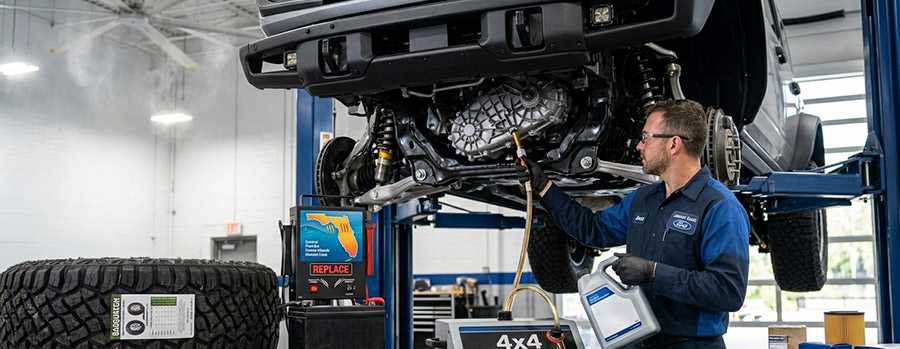
Protecting
the Driveline: Ford Bronco 4x4 Repair
The defining characteristic of the Ford Bronco is its legendary
go-anywhere capability. Whether your SUV features the standard part-time 4x4
system or the advanced automatic on demand 4x4 configuration, keeping these
sophisticated mechanical components properly serviced is crucial for ensuring
off-road reliability.
The
Mechanics of 4x4 Maintenance
When you engage your G.O.A.T. ModesFord (Goes Over Any Type of Terrain), an
intricate network of gears, shafts, and clutches engages to distribute power to
all four wheels. This system relies on highly specialized lubricants inside the
transfer case, front axle, and rear differential to reduce heat and friction.
|
Component
|
Function
|
|
Transfer Case
|
Distributes power smoothly between the front and rear wheels.
|
|
Front Axle / U-Joints
|
Delivers torque directly to the front wheels.
|
|
Rear Differential
|
Optimizes wheel speed and traction during turns and uneven
terrain.
|
Over time, heavy torque loads can break down these fluids. Furthermore,
if you cross deep water or tackle muddy trails, there is a risk that water or
fine silt can bypass the seals and contaminate the lubricants, potentially
leading to expensive gear damage.
Professional
4x4 Diagnostic and Repair Services
If you notice unusual fluid leaks under the center of the vehicle, hear
grinding or clicking noises when turning, or experience a delay when engaging
four-wheel drive, it is time to visit us for an expert Ford Bronco 4x4 repair.
Our service department is fully equipped to handle:
·
Driveline Fluid Exchanges: Routine flushing and replacing transfer case and differential fluids
with high-performance synthetic gear lubricants.
·
Axle Seal and Boot Replacement: Replacing worn seals and CV (constant
velocity) axle boots to keep moisture out and protective grease in.
·
Electronic Diagnostic Troubleshooting: Resolving codes related to the electronic
locking differentials or the transfer case control modules.
Trust
Your Bronco to the Experts at Jarrett Scott Ford
Your Ford Bronco is built to handle rugged conditions, but maintaining
its performance requires specialized expertise. The factory-trained, certified
technicians at Jarrett Scott Ford understand every inch of your vehicle’s
advanced powertrain, electronics, and suspension geometry.
We use state-of-the-art diagnostic equipment and genuine Ford OEM parts
to ensure every service meets the manufacturer's precise engineering
specifications. We make it easy to protect your vehicle's performance while
preserving its long-term resale value.
Don't wait for a warning light to appear on your dashboard. Whether you
need a quick tire rotation or a comprehensive drivetrain inspection, we are
here to help.
Let our team manage your maintenance routine so you can focus on your
next adventure with complete peace of mind.