
Signs It’s Time for Tire Replacement: Tire Care Guide for Plant City Drivers
12 November 2025
Did you know the average tire rotates enough times in its life to circle the Earth nearly twice? That’s about 50,000 miles of wear and tear but in a place like Plant City, where scorching summer heat, sudden downpours, and long commutes are part of daily life, your tires might not live out their full lifespan.
That’s why understanding when to replace your tires, how to spot tire sensor issues, and why valve stem maintenance matters are so important here. In this guide, we’ll break it all down for you, so you can stay safe on the road and get the most out of every mile whether you're heading to work in Lakeland, taking the kids to school, or cruising I-4 for a weekend getaway.
Here at Quick Lane® at Jarrett Scott Ford in Plant City, Drivers come in wondering if it’s time for new tires, or if that pesky dashboard light is just a faulty sensor. Sometimes, it’s not the tire at all; it’s a worn-out valve stem quietly leaking air and shortening your tire’s life without you even knowing it.
How to Know When It’s Time to Replace Your Tires
While most tires are rated for 40,000 to 60,000 miles, Florida’s high UV exposure, frequent rain, and hot asphalt can accelerate wear and degrade rubber compounds. That’s why a full tire inspection starting around 30,000 miles is recommended, especially if your daily drive includes long stretches of I-4 or stop-and-go traffic around town.
1. Tread Depth: Your First Line of Defense
Tread depth is critical for maintaining traction, especially on wet roads. As tread wears down, your tires lose their ability to channel water away, increasing the risk of hydroplaning.
- Legal minimum tread depth : 2/32 of an inch
- Recommended replacement depth : 4/32 of an inch for wet conditions, 5/32 for snow (if you travel north)
How to check:
Use a tread depth gauge for accuracy or try the penny test. Insert a penny into the tread with Lincoln’s head down. If you can see the top of his head, your tread is too shallow.
2. Sidewall Damage: Cracks, Bulges, and Dry Rot
The sidewall is the structural backbone of the tire. Damage here can’t be repaired and often signals the need for immediate replacement.
- Cracks: Caused by UV exposure and aging rubber, common in Florida’s sun-soaked climate.
- Bulges or bubbles: Usually the result of impact damage (like hitting a pothole or curb), indicating internal cord separation.
- Dry rot: A sign of aging rubber, often seen in tires over 5 years old, especially if the vehicle is parked outdoors.
3. Uneven Wear Patterns: A Symptom of Bigger Issues
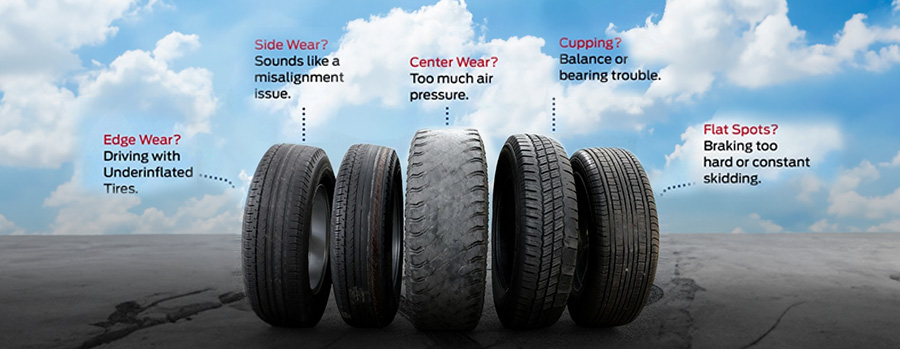
If your tires are wearing unevenly, it’s a sign that something else on your vehicle may be off. Replacing the tires alone won’t fix the problem, it’s important to address the root cause to avoid premature wear on your new set.
- Center Wear: Caused by overinflation, which makes the middle of the tire bulge and wear faster than the edges.
- Edge Wear: A sign of underinflation, where the tire’s outer edges bear more load and wear down quicker.
- Cupping or Scalloping: Uneven dips in the tread, often due to worn-out shocks or unbalanced wheels, causing the tire to bounce as it rotates.
Tip: If you notice any of these patterns, have your alignment, suspension, and tire pressure checked by a professional before installing new tires. It’ll help protect your investment and keep your ride safe and smooth.
4. Vibration, Noise, and Handling Changes
If your steering wheel shakes, or you hear a rhythmic thumping at highway speeds, your tires may be out of balance, separated internally, or worn unevenly.
- Vibration at low speeds: Likely a tire or wheel issue
- Vibration at high speeds: Could indicate tire imbalance or internal belt separation
- Pulling to one side: May be alignment-related or due to uneven tire pressure
Don’t ignore these signs. They often point to deeper issues that can shorten tire life or compromise safety.
5. Mileage and Age: Even Good-Looking Tires Can Be Unsafe
Tires degrade over time, even if they’re not heavily used. The rubber compounds lose elasticity, making them more prone to cracking and failure.
- Replace tires every 6 years, regardless of tread depth
- Check the DOT code on the sidewall for the manufacturing date (last four digits indicate the week and year of production)
- After 10 years, most manufacturers recommend replacing tires even if they appear unused
6. Frequent Air Loss or TPMS Alerts
If you’re constantly topping off your tires or seeing the Tire Pressure Monitoring System (TPMS) light, it could be a sign of:
- A slow leak from a puncture or cracked valve stem
- A failing TPMS sensor (battery life is typically 5–7 years)
- Bead leaks where the tire meets the rim, often due to corrosion or improper mounting
These issues can lead to underinflation, which increases rolling resistance, reduces fuel economy, and causes premature wear, especially on the outer edges of the tread.
Tips to Help Your Tires Last Longer
No one enjoys replacing tires more often than necessary. Fortunately, a few simple habits can help you get the most out of every mile:
1. Check Tire Pressure Monthly
Temperature swings in Florida can cause pressure to fluctuate. Keeping your tires properly inflated improves fuel economy and extends tire life.
2. Rotate Your Tires Regularly
Most vehicles need a tire rotation every 5,000 to 7,000 miles. This helps ensure even wear across all four tires.
3. Watch for Alignment Issues
Hitting a curb or pothole can knock your wheels out of alignment. Misalignment causes uneven wear and can shorten tire life.
4. Inspect Valve Stems and Caps
A missing or cracked valve cap can let in moisture and debris, leading to leaks.
5. Respond Quickly to TPMS Warnings
Ignoring a tire pressure warning can lead to underinflated tires, which wear out faster and reduce fuel efficiency.
What Your Tire Sensor Light Is Trying to Tell You
If your dashboard shows a tire warning light, your Tire Pressure Monitoring System (TPMS) is alerting you to a potential issue. It could be low pressure, but sometimes the sensor itself is the problem.
Here’s how to tell if your tire sensor might need replacement:
- The TPMS light stays on even after inflating your tires
- The light flashes when you start the car, then stays lit
- Your sensors are more than five to seven years old
If you're unsure whether it’s a pressure issue or a faulty sensor, don’t guess. Our certified technicians at Jarrett Scott Ford can quickly diagnose the problem and replace the sensor if needed.
Why the Valve Stem Deserves More Attention
The valve stem may be small, but it plays a big role in keeping your tires properly inflated. Over time, especially in Florida’s salty, humid air, the rubber can crack or corrode. This leads to slow leaks that no amount of air refilling can fix.
A quick valve stem replacement can prevent bigger problems like premature tire wear or sudden flats. It’s a simple service that can save you time and money down the road.
Ready for New Tires? We’ve Got You Covered
When you need new tires or a quick repair, we’re here to help. At Jarrett Scott Ford, we offer same-day tire replacement for most vehicles. No appointment is needed, and our team is trained to get you back on the road quickly and safely.
Tire maintenance doesn’t have to be expensive. Check out our online coupons and service specials for great deals. Visit Jarrett Scott Ford in Plant City for expert tire care and fast, friendly service.
Suspension problems are routine in the service bay, yet they seem to be so easy for Plant City drivers to overlook.
This is it, Plant City!
We are standing on the edge of the new year, with the Strawberry Drop at McCall Park just hours away and the winter harvest just around the corner. Whil
Welcome to Ford Focus ownership in the Winter Strawberry Capital of the World! Where your Ford faces Florida's infamous triple threat.
Let's cut through the marketing speak for a minute.
You bought a Ford because you wanted quality, reliability, and good American engineering. You probably paid $40,000, $50,000, m
The turkey leftovers are officially history folks! The Christmas decorations are already sparkling across Christmas Lane and McCall Park, and the “Great Holiday Road Trip” window
Many quick-lube places might offer a "top-off," but that is not a true service. At Jarrett Scott Ford, a professional air conditioning service is a systematic, multi-point procedu
See how transmission service is done, from draining old fluid to full-system flushes. Compare costs and service types at Quick Lane® at Jarrett Scott Ford in Plant City.
Living in Plant City means our "Fall" doesn't exactly look like a Hallmark movie. We don’t get crisp falling leaves, we get a slightly less humid breeze and possibly a sudden over
You’re washing your car or airing up your tires, and suddenly you spot the treads look thinner on one edge or completely smooth in certain spots. The first thought that pops up is