
Transmission Service Types & Costs
Transmission Service: How It’s Done and What It Costs
When people think of routine car maintenance, they picture oil changes, tire rotations, maybe topping off a few fluids. But the transmission often gets sidelined because it doesn’t demand attention as frequently as other components.
The early warning signs, like slight hesitations or soft gear shifts, are subtle enough that most drivers overlook them, and because the system is tucked away and complex, small issues can quietly grow into costly repairs. Your transmission is the heart of your car’s drivetrain and neglecting it can lead to serious trouble down the road. An ounce of prevention is worth a pound of cure, especially in the Sunshine State heat!

That’s why we’re breaking it all down, how transmission service actually works, why it matters, what it costs, and how the team at Quick Lane® at Jarrett Scott Ford keeps your ride healthy longer.
Automatic, CVT, and Manual Transmission Service
Transmission maintenance isn’t one-size-fits-all. Automatics require fluid exchanges and system checks, manuals need clutch and gear inspections, and CVTs depend on specialized service.
1. The Classic Automatic Transmission Service
Most vehicles on the roads around Plant City rely on traditional automatic transmission (AT). This system is a sophisticated blend of gears and hydraulic pressure, all powered by clean fluid. Our automatic transmission service is a thorough process that typically includes:
-
Fluid Check and Replacement: We drain the old, often thermally degraded or burnt fluid from the transmission pan. This fluid is crucial for lubrication, cooling, and transferring power. If your fluid is dark or smells acrid, you are definitely overdue!
-
Filter Replacement: Inside the AT pan is a filter that traps tiny metal particles and contaminants from normal wear. Replacing this filter with a high-quality part is essential to maintaining the system's cleanliness and health.
-
Pan Inspection and Gasket: Removing the pan allows our technician to visually inspect the bottom for excessive debris (a major warning sign) and install a fresh pan gasket to prevent leaks.
This procedure ensures that every component is attended to and gives you the benefits of smooth shifting once again.
2. The Modern Marvel: CVT Transmission Service
If you drive a newer vehicle with a Continuously Variable Transmission (CVT), you have a highly specialized system that uses belts or chains and pulleys instead of fixed gears. A CVT transmission service requires precision and the correct products:
-
Specific Fluid: CVTs demand a unique, highly engineered fluid. Using the wrong fluid can quickly lead to costly internal damage. Our factory-trained specialists know exactly which proprietary fluid your specific model requires.
-
Fluid Exchange (The Preferred Method): Due to the complex nature of the CVT system, a full fluid exchange is often recommended. This process removes all the old, potentially damaging fluid and replaces it with clean fluid, ensuring the delicate internal mechanisms operate perfectly.
Ignoring a routine CVT transmission service is a major gamble. Keep your high-tech drivetrain reliable, not high-stress!
3. The Hands-On Experience: Manual Transmission Service
For those of you who prefer to row your own gears, we haven't forgotten you! While manuals are simpler than automatics, their components still require lubrication and maintenance.
-
Fluid Check and Replacement: Manual transmissions use gear oil (sometimes called transmission fluid), which is thicker than AT fluid. This oil protects the syncros and gears. We drain the old oil, which can be full of metal filings and debris, and refill it with the correct, specified lubricant to ensure smooth engagement and longevity.
-
Inspection for Leaks: We check the seals and housing for any signs of leakage, which is critical since manual transmissions have a much smaller fluid capacity.
Don't let neglecting your manual transmission turn your exhilarating drive into a grinding headache!
How Transmission Service Is Done (Step-by-Step)
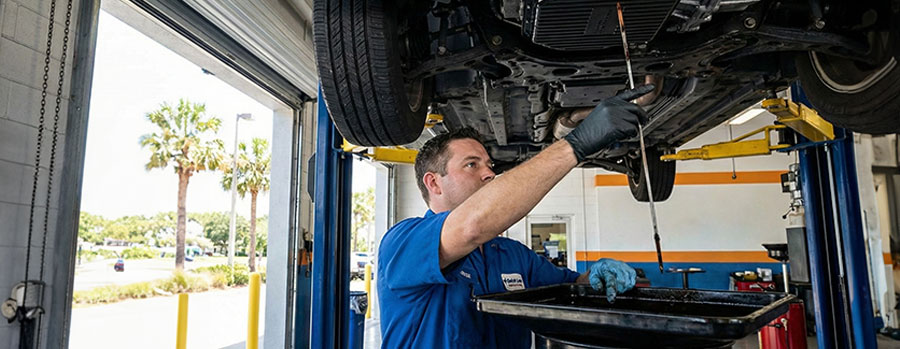
A transmission service is far more comprehensive than just "changing the fluid." It’s a precision process tailored to your specific vehicle. Here’s a breakdown of what happens when your car or truck comes into our Plant City service bay, noting which steps apply to your Automatic (AT), CVT, or Manual (MT) transmission.
|
Step |
Action Performed |
AT |
CVT |
MT |
Description |
|
1. |
Full Transmission Inspection |
|
|
|
Before any wrench is turned, the technician performs a complete evaluation: Checking fluid quality (burnt, dirty, low?), scanning for transmission fault codes (primarily AT/CVT), looking for leaks around seals and gaskets, and inspecting the pan and magnets for excessive metal shavings. This step alone is critical for catching early issues before they snowball into costly transmission repair service. |
|
2. |
Drain or Exchange Fluid |
|
|
|
Depending on your vehicle's type and fluid condition, the tech will either perform a gravity drain and refill (common for MTs and older ATs) or use a specialized machine to perform a fluid exchange. A fluid exchange replaces nearly ALL the fluid, which is highly beneficial for CVT transmission service, modern ATs, and trucks that tow regularly. |
|
3. |
Transmission Filter Replacement |
|
|
|
If your vehicle has a replaceable filter (most ATs do; MTs and CVTs often rely solely on fluid quality), the team will drop the pan, clean or replace the filter, clean the pan, replace the gasket, and reinstall the pan with precise torque specs. This helps remove trapped debris and improves overall flow. (Note: While CVTs and MTs typically do not have a user-serviceable filter, Step 2 is still essential.) |
|
4. |
Gasket and Seal Replacement |
|
|
|
Any worn or damaged gaskets and seals spotted during the inspection are replaced. A small leak today is a big repair tomorrow—Florida heat expands those components, making leaking more likely in all transmission types. |
|
5. |
Software Updates & Adaptation Resets |
|
|
|
Modern ATs and CVTs are controlled by sophisticated computers (the Transmission Control Module or TCM). Your technician may update the TCM software or reset shift adaptives. This ensures your transmission’s computer doesn't "remember" old shifting patterns or compensates for previously dirty fluid, optimizing shift quality and performance. |
|
6. |
Test Drive & Quality Check |
|
|
|
No car leaves without a real-world test drive through Plant City streets. The technician tests the shifting performance in various conditions: stop-and-go traffic, straight high-speed stretches, low-speed turns, and gradual acceleration. Everything must shift smoothly, cleanly, and consistently across all transmission types. |


What Does a Transmission Service Cost?
Transmission service isn’t a flat-price job and if someone quotes you without even asking what you drive, something is definitely being overlooked in the process. The cost depends on what you drive and what your transmission actually needs. A compact SUV, a heavy-duty truck, and a luxury sedan all have different fluid capacities, different internal components, and different service requirements, which naturally affect pricing.
A basic fluid drain-and-refill is the most budget-friendly option because it removes only a portion of the old fluid and replaces it with fresh fluid. It’s great for routine maintenance and keeping your transmission running smoothly, but it doesn’t clear out everything inside the system.
Transmission fluid exchange takes things a step further. Instead of just draining the pan, it cycles new fluid in while pushing more of the old fluid out. This gives you a more complete refresh and is ideal for vehicles that are due for service but aren’t showing any noticeable issues yet.
A full transmission flush is the most advanced service. Using specialized equipment, it pushes out nearly all old fluid, debris, and sludge that a drain-and-refill or basic exchange can’t reach. This deeper cleaning makes a flush ideal for high-mileage vehicles, CVTs that require precise fluid quality, or transmissions showing early signs of wear like slipping, shuddering, or delayed shifting.
Your transmission type matters too. Automatics, manuals, and CVTs all use different fluids and require different procedures. CVT fluid, for example, is engineered to handle belt-driven pressure and heat, which makes it more specialized and often more expensive than traditional automatic transmission fluid.
In the end, it comes down to a choice: routine maintenance costs a little now, or major repairs cost a lot later. For Plant City drivers, a standard automatic or CVT transmission service typically falls between $250 and $450, depending on fluid type and how thorough the service needs to be. Skip that service long enough, and contaminated fluid can cause gears, clutches, or belts to fail leading to repairs or full replacements that can run anywhere from $2,000 to over $5,500.
Disclaimer: The price ranges provided are local estimates and should be used for informational purposes only. The exact cost for your service transmission depends on your vehicle's specific make, model, year, fluid type, and current condition. For the most accurate and transparent quote using genuine parts, please contact the Jarrett Scott Ford Service Department directly. Prices are subject to change.
The Quick Lane® at Jarrett Scott Ford Advantage: Local Experts for Local Drivers
We live and work in Plant City, just like you. We know that life here revolves around getting to the Friday night high school football game, grabbing some fresh produce at Parkesdale Market, or planning a weekend trip down to the Gulf Coast. You need a reliable vehicle to do all that!
Your transmission shouldn't be a mystery or a source of anxiety. It should be a well-oiled machine that lets you enjoy the drive.
We’ll get your ride shifting perfectly and have you back on the roads of Plant City and Hillsborough County in no time!