
Ford F-150 Engine Maintenance & Repair Guide
For decades, the Ford F-150 has been built to tackle tough jobs, tow heavy loads, and handle daily Florida commutes without breaking a sweat. But whether your truck relies on a legendary V8 workhorse or a twin-turbocharged EcoBoost powertrain, keeping your vehicle performing at its peak requires knowing how to care for what's under the hood.
At Jarrett
Scott Ford, we help drivers throughout Plant City help to diagnose unexpected
engine lights on the F-150 or when performance begins to degrade. Understanding
your specific engine setup is the first step toward getting back on the road
safely.
Understanding Your F-150
Engine Generation
Over the years, Ford has
equipped the F-150 with several distinct powertrain options. Knowing which
engine powers your truck makes a major difference when scheduling maintenance
or diagnosing potential issues:
|
Engine Option
|
Configuration
|
Notable Characteristics
& Service Focus
|
|
F-150 4.6 Engine
|
2V / 3V Modular V8
|
Known for bulletproof
reliability; requires routine spark plug and coil pack inspections.
|
|
F-150 5.4 Engine
|
3V Triton V8
|
Delivers strong low-end
torque; benefits from timely oil changes to prevent cam phaser rattle.
|
|
F-150 5.0 Engine
|
Coyote DOHC V8
|
High-revving, naturally
aspirated power; requires quality full-synthetic motor oil and cooling
checks.
|
|
Ford F-150 EcoBoost
Engine
|
2.7L / 3.5L Twin-Turbo V6
|
Massive low-rpm torque;
demands strict oil change intervals to protect high-speed turbo bearings.
|
If you own an electric
F-Series truck, check out our specialized F-150 Lightning Maintenance and Service Guide.
Essential Ford F-150
EcoBoost Engine Service Tips
The Ford F-150
EcoBoost engine revolutionized light-duty truck performance by combining
direct fuel injection with dual turbochargers. While these engines offer
exceptional towing power and fuel efficiency, the increased heat and pressure
within the combustion chamber make routine maintenance critical.
Key routine tasks for Ford
F-150 EcoBoost engine service include:
-
Frequent
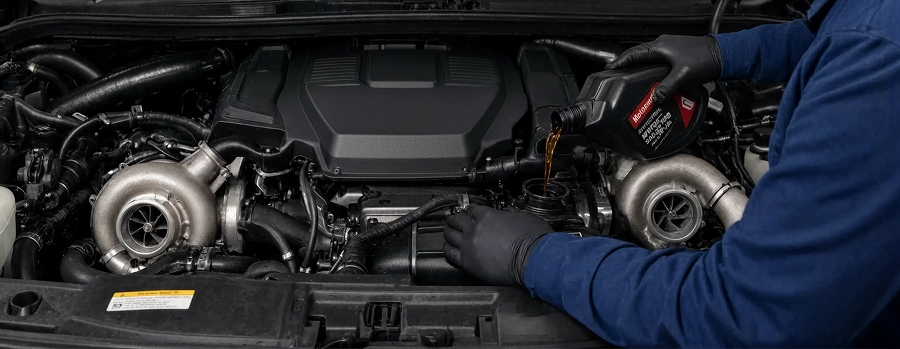
Synthetic Oil Changes:Turbocharger bearings spin at upwards of 100,000 RPM and rely directly on
engine oil for cooling and lubrication. Using premium Motorcraft®
full-synthetic oil prevents heat breakdown and carbon buildup.
-
Spark
Plug Gapping & Replacements: Forced-induction engines place higher
stress on ignition components. Replacing spark plugs at recommended intervals
prevents misfires under heavy acceleration.
- PCV Valve & Intake Air Checks: Ensuring your Positive Crankcase Ventilation (PCV) system and air filters are clean prevents oil vapor accumulation inside the intake system.
Adopting proactive care
habits as part of your car maintenance routine to avoid breakdowns helps extend the
lifespan of your EcoBoost turbos well past the 100,000-mile mark.
Common F-150 Engine
Repair Issues & Symptoms
When engine components
begin to wear down, each Ford powertrain family exhibits distinct diagnostic
clues. Spotting these symptoms early can save you thousands in secondary engine
damage:
1. EcoBoost "Stutter" Under Acceleration &
Cold-Start Rattle
- The Symptom:A subtle shudder or misfire when stomping on the gas pedal to pass on I-4, or a loud 2-to-3-second metallic rattle from the front cover upon cold engine startup.
- The Repair Fix:Acceleration stutter on a Ford F-150 EcoBoost engine is often caused by spark plug gap erosion under high boost or moisture accumulation in the charge air cooler (intercooler). The cold-start rattle typically points to primary timing chain stretch or worn Variable Cam Timing (VCT) phasers, requiring a timing component refresh.
2. The F-150 5.4 Engine "Diesel Rattle" at Warm
Idle
- The Symptom:Your V8 runs quietly when cold, but once warmed up at a drive-thru or stoplight, it develops a deep ticking or rattling noise that sounds like a diesel engine.
- The Repair Fix:This classic issue on the F-150 5.4 engine stems from low oil pressure at the top end, causing VCT cam phasers to knock against their housing stops. Fixing this involves replacing the phasers, timing chains, and upgrading to a high-volume oil pump.
3. F-150 5.0 Engine Coolant Hose Leaks & Misfires
- The Symptom:Small puddles of orange/pink coolant under the front crossmember or a gradual drop in the coolant reservoir level without obvious hose splits.
- The Repair Fix:On the F-150 5.0 engine, the quick-connect plastic T-connector o-rings on the upper radiator hose degrade over time from engine bay heat cycles. Replacing the T-connector or o-rings restores your cooling loop before overheating occurs.
4. F-150 4.6 Engine Cold Exhaust Ticking
- The Symptom:A rhythmic ticking sound from the wheel wells that is loud when cold but fades as the engine warms up.
- The Repair Fix:The F-150 4.6 engine is famous for snapping rear exhaust manifold studs due to thermal expansion. Replacing the warped manifold and installing heavy-duty stainless steel studs resolves the leak.
Diagnosing an F-150
Check Engine Light
Nothing interrupts a
morning drive through Plant City quite like seeing a glowing F-150 check
engine light appear on your dashboard.
When an engine light
on an F-150 turns on, your truck’s On-Board Diagnostics (OBD-II) system has
logged a specific fault code. Here is how to interpret common diagnostic codes:
|
Diagnostic Trouble Code
(DTC)
|
Primary Meaning
|
Common Root Cause
|
|
P0300 - P0308
|
Cylinder Misfire Detected
|
Worn spark plugs, failing
ignition coil pack (COP), or clogged fuel injector.
|
|
P0299
|
Turbocharger Underboost
|
Stuck wastegate actuator,
cracked boost hose, or leaking intercooler coupler on EcoBoost models.
|
|
P0012 / P0022
|
Camshaft Position
Over-Retarded
|
VCT solenoid failure,
sludged oil passages, or timing chain alignment issues.
|
|
P0420 / P0430
|
Catalyst System
Efficiency Below Threshold
|
Failing catalytic
converter, often caused by driving long distances with an unaddressed
misfire.
|
Dashboard Warning Tip: Modern Ford trucks
feature multiple active driver-assist systems. If your check engine light is
accompanied by stability or traction control warnings, explore our diagnostic
guide on what the Ford AdvanceTrac service light means.
When You Need
Professional Ford F-150 Engine Repair
While basic maintenance
like air filters and top-offs can be handled in your driveway, complex Ford
F-150 engine repair tasks require factory-certified diagnostic equipment,
specialized pullers, and precise torque specifications.

You should seek immediate
professional repair if you notice:
·
Severe
power loss or "Limp Mode" activation while hauling or towing.
·
Blue
smoke from the tailpipe (oil burning in turbo bearings or valve guides) or
thick sweet-smelling white smoke (head gasket leak).
·
Heavy
steering wheel vibration alongside engine noise—and if your steering wheel
feels heavy, check our power steering repair guide for fluid leaks and stiff
steering.
·
Clunking
over bumps alongside engine vibrations, which could also point to worn suspension parts affecting your drive stability.
When handling complex
powertrain diagnostics, discover why certified Ford service beats generic repair shops when it comes to factory
diagnostic accuracy, OEM parts fitment, and specialized technician training.
Keep Your F-150 Running
Strong at Jarrett Scott Ford
Whether you need a
routine Ford F-150 EcoBoost engine service, a check engine light diagnostic, or
comprehensive repairs for a classic F-150 5.4 engine, 5.0 engine, or 4.6
engine, the factory-trained technicians at Jarrett Scott Ford are here to help.
Before planning your next long trip or heavy haul, perform essential pre-trip vital vehicle checks or visit our service center in Plant City, FL, to keep your F-150 performing like new!